agent-task begin
Start from an explicit task and scope before broad repository exploration.
// .knowledge 3.4.0 · Apache-2.0
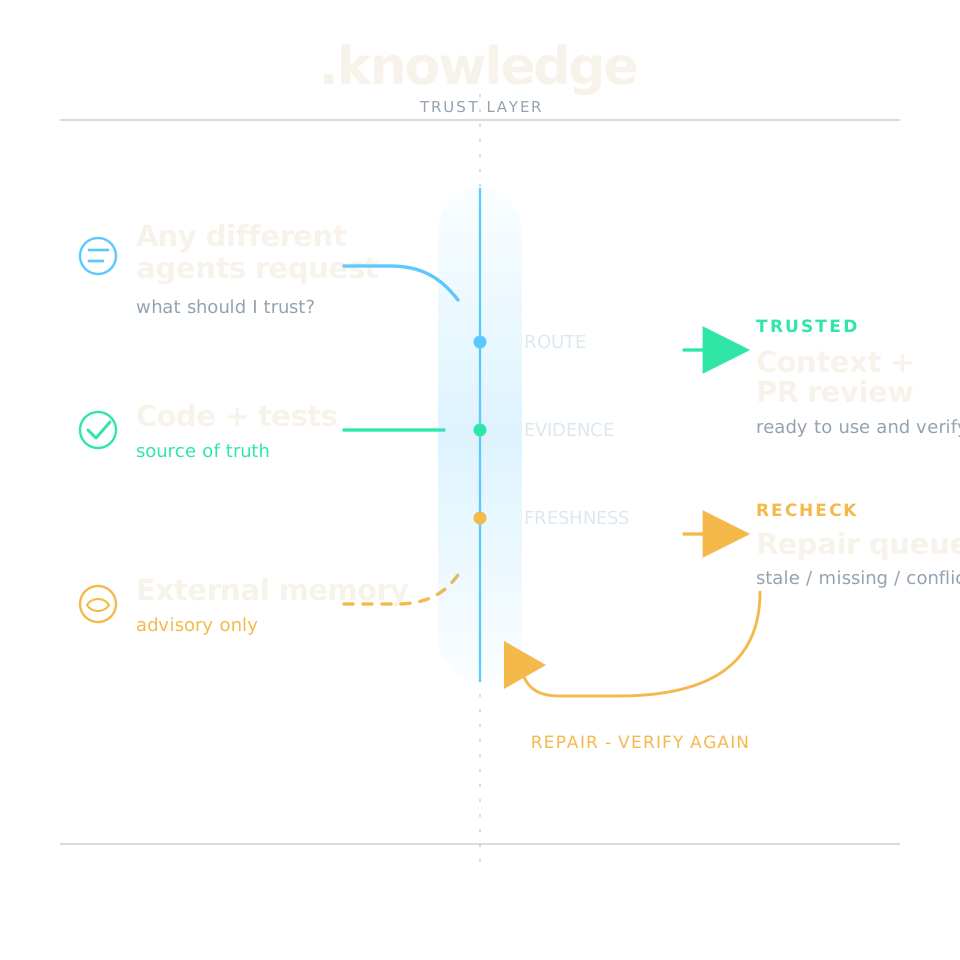
.knowledge lives inside your repository and tells connected coding agents what to read, what is evidence-backed, what is stale, what needs repair, and what a reviewer should verify before merge.
Current code and tests remain the source of truth. External memory stays advisory.
Now available: .knowledge 3.4.0
3.4.0 updates
Task routing / focused starting context / real builds and tests / safe reuse of verified results
// one focused workflow
The 3.4.0 workflow connects task routing and engineering checks while keeping any follow-up work visible for review.
agent-task beginStart from an explicit task and scope before broad repository exploration.
The workflow records the selected files so finish can confirm that the task used the same starting context.
The primary engineering work is verified with physical commands and tests, not a summary alone.
agent-task finishVerified results can be reused when the same checks safely cover a repair; retries resume safely and incomplete repairs stay visible.
// the adoption gap
These figures describe developer sentiment and workflow plans, not .knowledge
product performance.
Source: Stack Overflow Developer Survey 2025.
.knowledge exists to change these numbers. Its mission is to make AI-assisted repository work trustworthy enough to review, commit, and merge with evidence instead of guesswork.
// problem
A stale note can be fluent, relevant, and wrong after the code changes.
Retrieved context is useful, but it should never silently override current code and tests.
Documentation, module summaries, decisions, and handoffs age at different speeds.
A diff shows changed lines. It does not show which trust boundary or stale knowledge was affected.
Without evidence and freshness metadata, reviewers cannot see why an agent believed something.
// agent compatibility
// 3.4.0 release evidence
.knowledge 3.4.0 joins a task-specific route to its focused starting
context, verification with real builds and tests, and safe reuse of verified results.
Below are the compatibility and routing checks completed for this release.
agent-task begin produces an explicit task route before broad exploration begins.
The task finishes against the same set of starting files it began with, making scope changes visible.
A passing test or build can be reused when it safely covers the same follow-up item.
Interrupted work can resume safely, and incomplete items remain open for review.
Repository-wide health and the readiness of the current task are shown separately.
Reviewers can see the route, completed checks, and any remaining work as separate results.
Routing figures below are deterministic local first-read byte measurements. They are not provider tokens, API cost, runtime speed, or a model-accuracy result.
| Evidence set | Result | Scope |
|---|---|---|
| OS / Node matrix | 9 / 9 | Windows, Ubuntu, and macOS on Node 18, 20, and 22 |
| Shipped self-test executions | 243 / 243 | 27 shipped self-tests in each of 9 matrix cells |
| Integration bridges | 12 per cell | Each compatibility-matrix cell |
| Exact upgrades | 3 / 3 | 3.2.11 → 3.4.0 on Node 22, once per OS |
| End-to-end verification | All checks passed | Packaging, clean install, upgrade, routing, Inspector, and lock-safety checks |
| Measure | Result | Interpretation |
|---|---|---|
| Routes | 48 / 48 | Every test route kept the expected source and dependencies in view. |
| Module selection | 3,584 → 96 | Modules considered versus selected across the test workspaces. |
| Median first-read reduction | 90.77% | Corrected median of local first-read bytes, not provider tokens or cost. |
// product modules
The compact first-read map for agents.
Claims linked to real project files, builds, and tests.
Clear status before repository information is used.
Outdated or unverified context shown as visible work.
Changed files mapped to the repository areas they affect.
Local dashboard over trust state.
Instructions and reusable workflows for supported coding agents.
Optional memory that remains secondary to current code and tests.
Find relevant repository information without loading everything.
// operating model
.knowledge verifies. Humans review.Use the routing bundle, evidence, and current trust state.
Detects drift, grades freshness, records repair work, and builds PR impact.
See why knowledge is trusted, what needs recheck, and what blocks merge readiness.
Keeps the artifacts local, inspectable, and reviewable beside the code.
// visual inspector
The free, open-source core includes a local read-only Inspector for checking health, confidence, freshness, follow-up work, linked documentation, and PR-review readiness.
// memory providers
Memory providers can help agents remember conversations and retrieved context.
.knowledge keeps that memory behind source, tests, and evidence.
Self-hosted memory for agent conversations and context recall across different agents, kept advisory inside the trust layer.
Optional vector memory status for teams that already use managed retrieval infrastructure.
Better suited for Pro or Enterprise workflows that need graph memory, managed history, or fleet-level governance.
// FAQ
Current code first, current tests second, then evidence, modules, decisions, wiki, sessions, and external memory last.
.knowledge require cloud, login, or telemetry?No. The free core is repo-local and does not require cloud sync, account login, or telemetry to run.
.knowledge an IDE?No. Coding agents and editors still do the work. .knowledge provides the trust, routing, freshness, repair, and review layer beside the code.
No. It does not guarantee correct edits. It makes trust state, evidence gaps, stale context, and repair work visible before agents and reviewers rely on repository knowledge.
No. That download is a source snapshot. Use the uploaded Release asset only, then extract it so .knowledge/ sits at the repository root.
No. Code and tests beat summaries. Evidence beats prose. External memory stays advisory.